
n0de
Turning two founders' heads into a repeatable product
n0de is an early-stage startup enabling organisations to decarbonise.
Role: Founding Senior Product Designer → Head of Product Design
Team: Me, plus co-founders Scott Ferraro and Rob Brimblecombe, CTO Adrian and Software Engineer Charlie
Timeline: Aug 2023 – Jan 2024 (first research cycle ~8 weeks per business, compressed to ~1 day by the end)
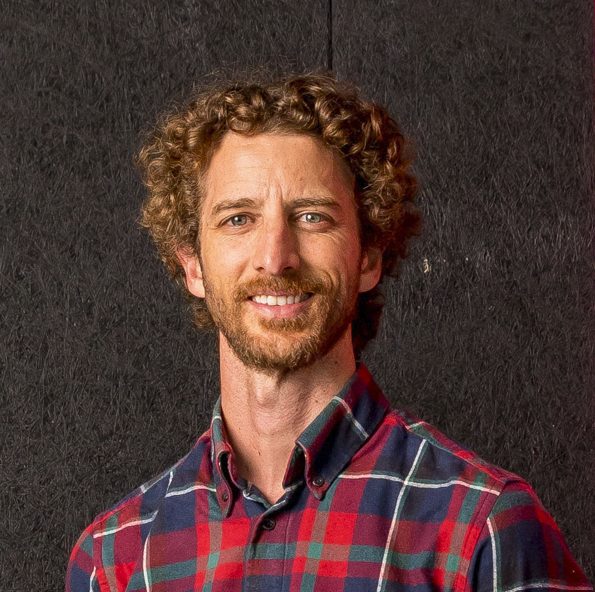
“I loved working with Jess at n0de. She has that rare product design ability to take a messy idea, understand what it’s really trying to do, and turn it into something clearer, sharper and better than it was when it started.
At n0de she helped us move from big, sometimes half-formed thinking about net zero action into actual customer experiences, product flows, prompts, processes and deliverables that people could understand and use. She brought a great mix of curiosity, structure, creativity and execution, always with a strong feel for the customer and what would actually help them move forward.
Jess also made the work better just by being in it. I’d very happily work with Jess again, and I’d thoroughly recommend her to anyone looking for a brilliant product/design thinker who can turn ideas into something real. If you are in the clean energy / net zero space and looking for a product person, Jess is it!!!”
— Scott Ferraro, Co-Founder @ n0de
Challenge
n0de’s co-founders held deep expertise in Net Zero transition (previously leading the charge at Monash University) and no product yet. I joined as the first design hire before there was anything to design.
We knew we wanted to help more businesses transition to a Net Zero future. What we didn't have was a process for getting there, or any evidence our ideas would actually work on a real business rather than in theory. And underneath that, Scott and Rob had years of Net Zero expertise between them, but it lived in their heads. To enable n0de to move beyond bespoke consulting, that knowledge had to become something repeatable that didn't need either of them in the room.
Process
Building the internal process.
Nothing about the "5 and 5" format existed before we built it. As we worked together, we worked out what data we actually needed, what order to gather it in, and how to interview a business owner who cared about sustainability but had no idea where to start. I started designing a starter artifact for how to communicate everything back to them with the goal that they’d take the next step and act.
I tested comms and campaign assets, iterating on language and framing off real feedback rather than guessing at it. "How do we make the world's first net zero pickle?" is the line that stuck, and it stuck because it was specific and true and deeply rooted in language we directly heard from our customer, Dillicious.

Research, discovery, recruitment.
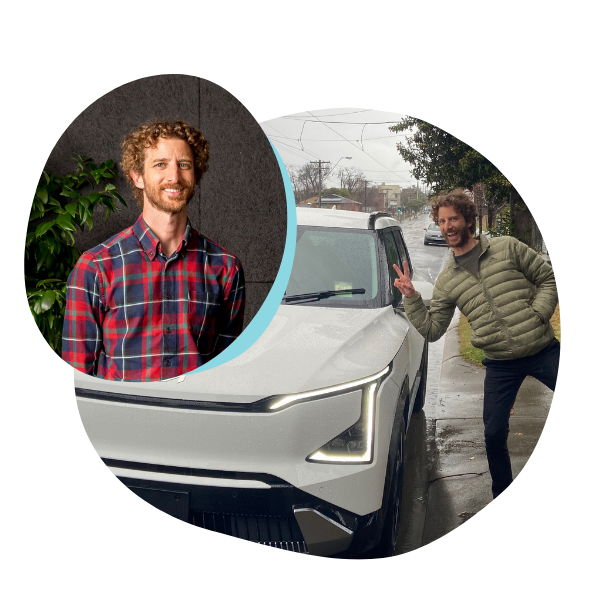
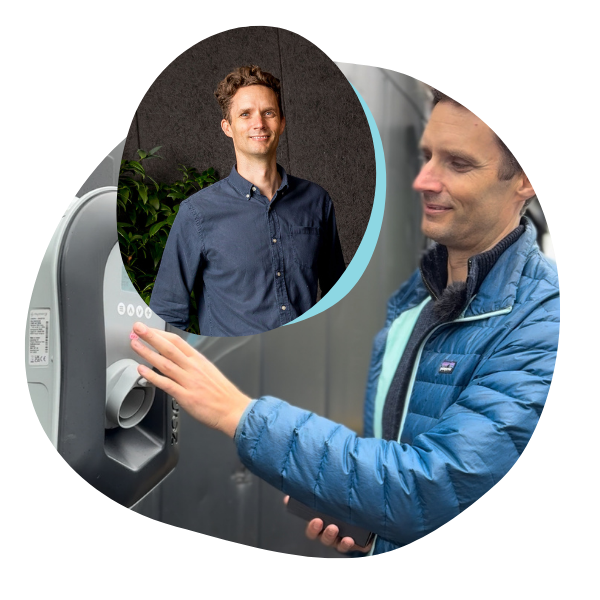
Alongside Scott, I recruited and ran research across five early-adopter small businesses, a campaign we named "5 in 5." That meant sourcing participants, running interviews, visiting sites where it made sense to, and gathering emissions data business by business. It was a slow and painful process but yielded so much value in uncovering many deeper layers of challenge and problems to solve.

Getting Scott and Rob's expertise out of their heads.
Once the manual process felt right, the next job was turning what they knew and built into something we could take steps to productise. That meant spending time with both of them, diving deep into their process, data use and calculations, to see what I might be able to build from it. I mapped everything in Whimsical in a large experience map to get it all written down and clear.
This landed right as ChatGPT came online. I built a prompt library from what we'd pulled out of Scott and Rob's heads, covering emissions baselining and the Scope 1/2/3 GHG Protocol chain, and tested the outputs against the plans we'd already produced by hand to see how close they got.
Once that held up, I chained the prompts manually into a two-step process, one part pulling and structuring raw data, the next generating a usable plan. There wasn't tooling to do that automatically yet, so it was pretty hands-on to put together.
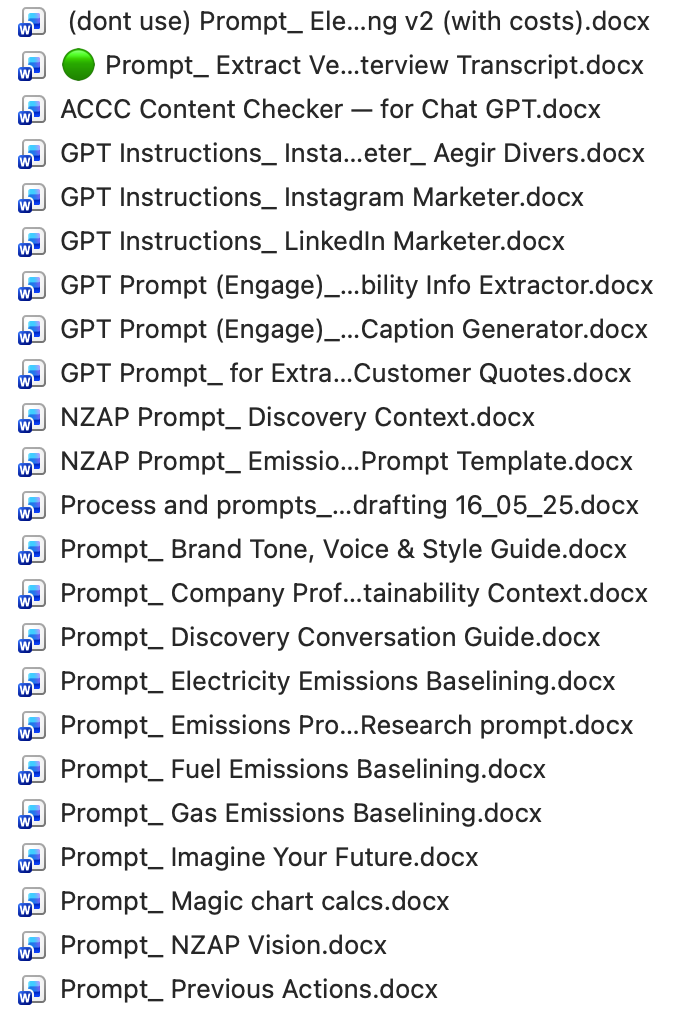
Building and testing a prompt library.
Solution
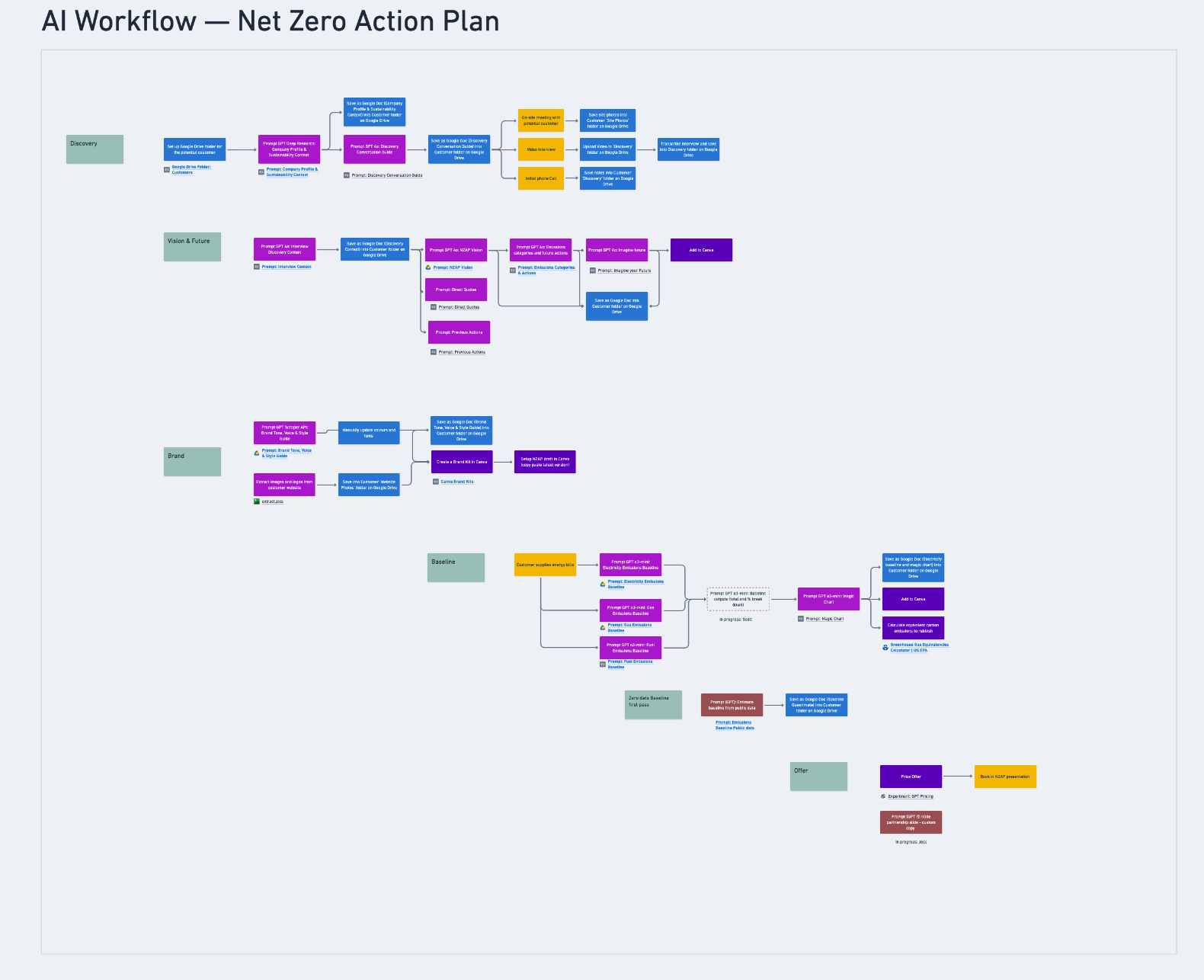
By the end, the team had a process that could take a business from first contact to a Net Zero Action Plan in around a day instead of eight weeks, built on the same judgement Scott and Rob had always used, just less dependent on them personally running every step.
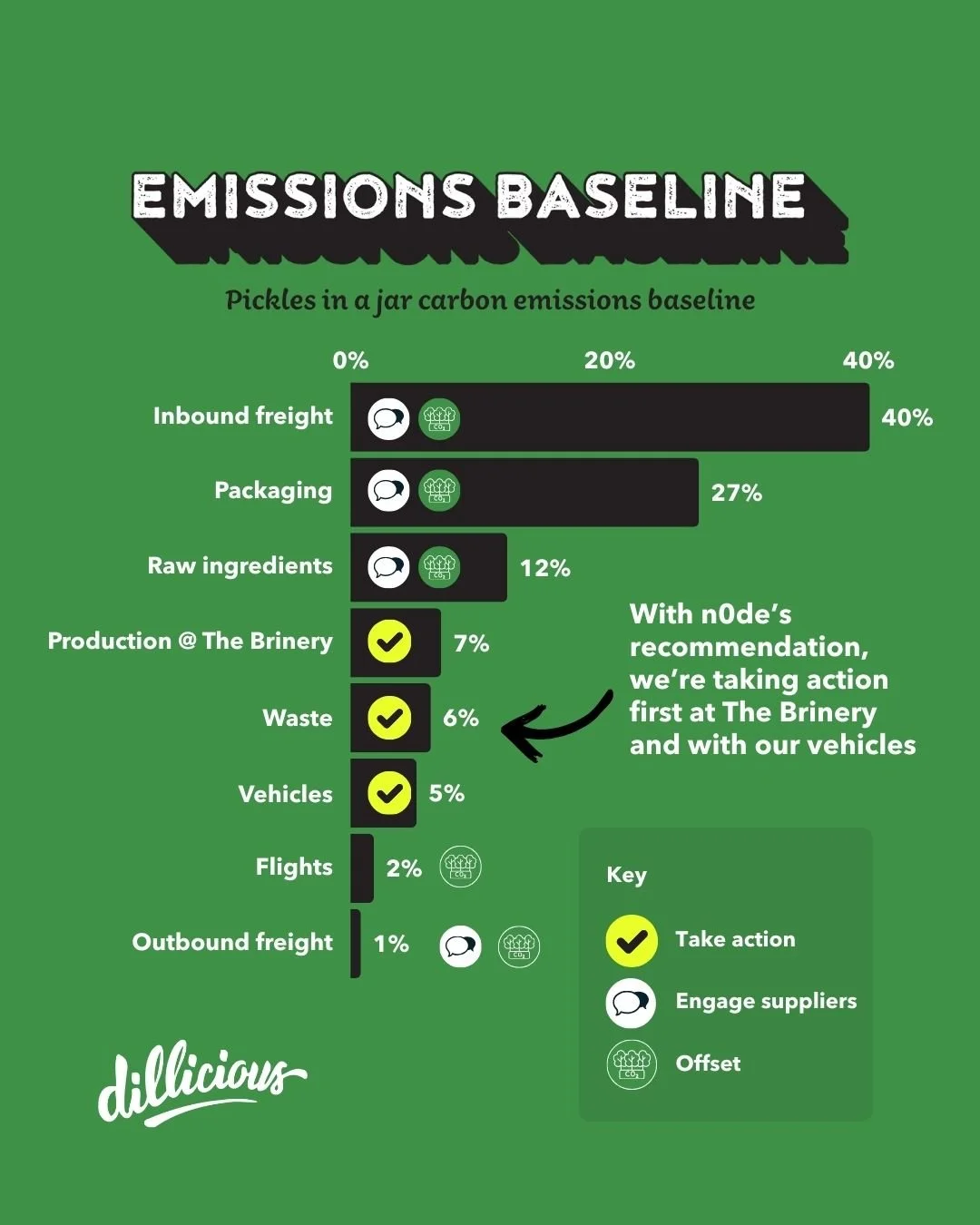
For Dillicious, that sat underneath a 10kW solar install completed a year after the baseline, a public plan we hosted online and campaign assets built from the plan's own numbers. James Barbour, Dillicious's founder, had been pitched solar by around six providers before working with us. His read: "Working with n0de allowed us to do what we’d always wanted to do, but hadn’t been able to."
Impact
A tested prompt library and manual workflow that cut an eight-week process down to about a day
Scott and Rob's expertise turned into something the team could run without needing both of them in every session
A repeatable campaign format ("5 and 5") that showed the plan actually changed what a business did next
For Dillicious specifically: baseline established, solar delivered, and now looking into their first EV van
What I'd do differently: The advancement in AI capability would improve the capability of this tooling, so less of doing things differently and more of keeping an eye on future opportunity. A lot of what made this trustworthy was checking it against judgement calls and evaluating against human output, so continuing to keep that in the loop is paramount.
Reflection
This is a harder chapter to show off than most, because most of what came out of it isn’t flashy UI: a research process, a prompt library, deep experimentation, collaboration and transformation of subject matter expertise into an early-stage product layer.
But it's a good example of what it actually looks like to build something with a small team and no established process to lean on, working out what mattered together, then finding a way to learn, iterate and keep moving forward.
Thank you